
Five Continuity Myths That Keep Wealthy Families Structurally Exposed
Why successful families should test comfortable assumptions before transition pressure begins
The most dangerous continuity risks in a successful family rarely look irresponsible.
They often look reasonable.
A family has assets.
The business is profitable.
The children are educated.
The Will may be done.
The CA and lawyer are known to the family.
There is no visible conflict.
The founder is still active and respected.
So everyone says the same thing:
“Everything is sorted.”
Sometimes, that may be true.
But in many business families, “sorted” does not mean structurally ready.
It means the founder is still holding the picture together.
He remembers the asset history.
He knows which child received support earlier.
He understands which property should not be sold.
He knows which banker will cooperate.
He knows which document exists, which advisor has which file, and which family conversation should be handled carefully.
The family may not be careless.
It may be partially planned.
And partial planning can be dangerous because it creates confidence before alignment.
That is where continuity myths begin.
They are not foolish beliefs.
They are comfortable beliefs.
They sound practical, responsible, and emotionally safe.
But if they are never tested against ownership, authority, liquidity, documentation, family roles, and implementation reality, they can leave even wealthy families structurally exposed.
A discreet pattern seen in many successful families
Consider a founder-led family with a profitable business, substantial property, a prepared Will, and long-standing advisors.
From the outside, the family appears organised.
But the Will does not explain which child is ready to manage the operating company.
The properties cannot be divided without emotional and commercial pressure.
One branch has received quiet support over the years, but it was never documented clearly.
Liquidity depends on the founder’s personal relationship with bankers.
The CA knows the accounts.
The lawyer knows the documents.
The banker knows the facilities.
But no one is holding the full continuity map.
This family is not unplanned.
It is incompletely aligned.
That is often the real issue in serious families.
Not absence of wealth.
Not absence of love.
Not absence of advisors.
Absence of structural testing.
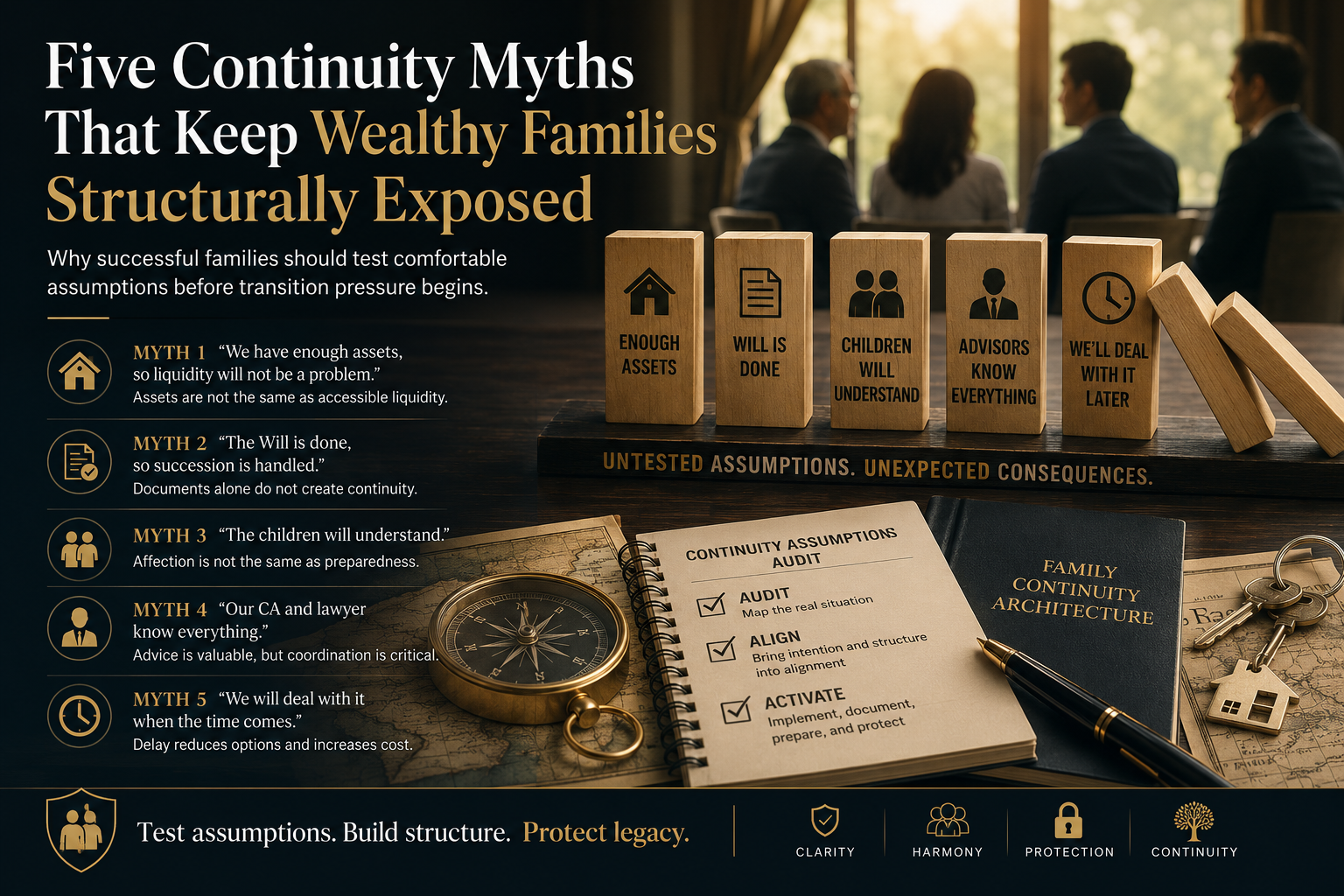
Myth 1: “We have enough assets, so liquidity will not be a problem.”
This is one of the most common assumptions in wealthy families.
The family owns land, buildings, business shares, private investments, jewellery, deposits, and other assets.
So liquidity feels safe.
But asset value is not the same as usable liquidity.
A property may be valuable but difficult to sell quickly.
A business may be profitable but unable to release cash without weakening operations.
Shares may carry value but selling or pledging them may affect control.
A jointly held asset may be legally available but emotionally difficult to use.
A family may have wealth, but no clean source of transition liquidity.
The real question is not:
“How much are we worth?”
The better question is:
“If liquidity is needed at an inconvenient time, what exactly can be accessed, who can approve it, how fast can it move, what will it cost, and what will it disturb?”
That question reveals more than a balance sheet.
It reveals whether wealth has been prepared for real life.
Liquidity should not be discovered during pressure.
It should be designed before pressure arrives.
Myth 2: “The Will is done, so succession is handled.”
A Will is important.
In many families, it is essential.
But a Will is not the entire continuity architecture.
A Will may say who receives what.
It may not clarify who can act during incapacity.
It may not align with nominations, shareholding, partnership records, family arrangements, trusts, or shareholder agreements.
It may not explain the founder’s intent behind unequal support, business control, or asset allocation.
It may not create liquidity for settlement, tax, debt, or equalisation.
It may not prepare the next generation for responsibility.
It may not coordinate the CA, lawyer, banker, trustee, and family decision-makers.
Documents matter.
But documents in isolation can create false comfort.
A family must ask:
Do the documents match actual ownership?
Do they reflect current family realities?
Do they support business continuity?
Do they provide authority when action is needed?
Do they align with liquidity requirements?
Do they reduce ambiguity, or merely transfer it to the next generation?
The Will may be complete.
But the continuity structure may still be incomplete.
Myth 3: “The children will understand.”
Many founders believe this sincerely.
They trust their children.
They believe the family will remain practical.
They believe affection will prevent conflict.
They believe educated children will handle matters maturely.
They believe informal conversations are enough.
Sometimes they are right.
But affection is not the same as preparedness.
Children may love each other and still interpret fairness differently.
One child may be active in the business.
Another may be financially dependent.
One branch may value control.
Another may prefer liquidity.
One child may feel past contribution was not recognised.
Another may feel past support was not accounted for.
These are not signs of a bad family.
They are normal realities when wealth, roles, responsibility, and expectations become complex.
The next generation should not inherit only assets.
They should inherit context, decision discipline, governance clarity, and a shared understanding of the founder’s intent.
A serious family should ask:
Do the children understand the asset map?
Do they understand which assets are sensitive?
Do they understand business versus family capital?
Do they know how decisions will be made?
Do they understand why certain arrangements exist?
Have difficult expectations been clarified while the founder is still present?
The children may understand emotionally.
But continuity requires structural understanding.
Myth 4: “Our CA and lawyer know everything.”
Most successful families already have advisors.
That is good.
They have a CA.
They have a lawyer.
They may have bankers, investment advisors, insurance advisors, company secretaries, trustees, and internal finance teams.
The issue is usually not lack of advice.
The issue is fragmentation.
Each advisor may know one part of the family’s life.
The CA may know tax, accounts, and entities.
The lawyer may know documents.
The banker may know facilities and security.
The investment advisor may know portfolios.
The insurance advisor may know risk cover.
The family may know the emotional history.
The founder may know the real intention.
But who is examining whether all these parts work together?
Who is asking whether documents, ownership, liquidity, authority, business continuity, family expectations, and implementation sequence are aligned?
Who is coordinating the questions before transition pressure begins?
That is the missing layer in many families.
Not another advisor working in isolation.
A continuity map.
The family’s professionals are valuable.
But without coordination, even good advice can remain trapped in separate files.
Myth 5: “We will deal with it when the time comes.”
This assumption feels practical.
The founder is busy.
The business needs attention.
The family does not want unnecessary discussion.
No crisis is visible.
Difficult conversations can be postponed.
So the family waits.
But continuity work becomes more difficult after pressure begins.
After illness, incapacity, death, dispute, debt pressure, tax urgency, or branch-level disagreement, the family’s options reduce.
Documents are searched in haste.
Liquidity becomes expensive.
Advisors become reactive.
Family members interpret intention differently.
Old support becomes evidence in someone’s mind.
Control can become vulnerable.
Decisions carry emotional weight.
The same conversation that could have been handled calmly earlier becomes sensitive later.
That is why timing matters.
Continuity should be reviewed while the founder is active, the family is calm, and the choices are still dignified.
The right time is not when the family is forced to act.
The right time is when the family can still design.
The Continuity Assumption Audit
Before a successful family accepts that everything is sorted, it should test its most repeated assumptions.
I call this the Continuity Assumption Audit.
Its purpose is not to create fear.
It is not to disturb family peace.
It is not to turn every matter into legal drafting or financial product discussion.
It is a private, structured review of whether the family’s comfortable beliefs are supported by actual architecture.
The central question is simple:
Which family assumptions are structurally supported, and which are only verbal comfort?
The 3A continuity move: Audit, Align, Activate
A continuity review should not remain theoretical.
It should move through three stages.
1. Audit
The first step is to map reality.
Not the version held in memory.
Not the version assumed by one advisor.
Not the version discussed casually in the family.
The real situation.
What does the family own?
Who controls what?
Which assets sit in individuals, companies, LLPs, HUFs, trusts, partnerships, or joint names?
Which documents exist?
Which documents are outdated?
Which nominations conflict with intention?
Where is liquidity available?
Where is cash trapped?
Which decisions depend on the founder personally?
Which family expectations are undocumented?
Which advisors hold which part of the picture?
The audit does not solve everything.
It reveals what must be solved.
2. Align
Once the reality is visible, the family can begin alignment.
Founder intention must align with ownership.
Documents must align with current assets.
Liquidity must align with transition risk.
Family roles must align with responsibility.
Successor readiness must align with future authority.
Business continuity must align with personal estate planning.
Professional advice must align across CA, lawyer, banker, trustee, insurance advisor, and family decision-makers.
This is where many families discover that the problem is not one missing document.
The problem is disconnected parts.
Alignment turns scattered arrangements into continuity architecture.
3. Activate
A review has limited value unless it leads to implementation.
Activation may include:
updating documents,
clarifying authority,
coordinating advisors,
creating liquidity pathways,
preparing successors,
recording founder intent,
reviewing ownership structures,
separating business and family capital,
designing governance processes,
funding continuity requirements,
and assigning responsibility for next steps.
This is where continuity becomes practical.
Not merely discussed.
Implemented.
Why this matters for the founder
For the founder, this review is not about surrendering control.
It is about protecting the meaning of control.
A founder has spent decades building wealth, reputation, relationships, and family stability.
The purpose of continuity architecture is not to push him aside.
It is to ensure that his judgment, intention, and life’s work do not remain trapped only inside his memory.
A well-structured review allows the founder to guide the next stage while he is still respected, active, and able to explain the logic.
That is far better than leaving the family to guess later.
Why this matters for the next generation
For the next generation, continuity is not only about inheritance.
It is about readiness.
They need to understand more than asset allocation.
They need to understand why certain assets matter.
Which relationships must be preserved.
Which decisions require restraint.
Which parts of the business should not be disturbed.
Which obligations must be honoured.
Which liquidity should be protected.
Which family behaviours can damage trust.
Ownership without preparation can create confusion.
Preparation without structure can remain only conversation.
Continuity requires both.
Why this matters for advisors
For CAs, lawyers, bankers, trustees, and other professionals, this review creates clarity.
It does not replace them.
It helps coordinate the right questions.
The CA may need to review tax and entity implications.
The lawyer may need to update documents.
The banker may need to clarify facilities and security.
The trustee may need to understand intent and obligations.
The insurance advisor may need to evaluate continuity funding.
The family may need to clarify roles and expectations.
When these conversations happen separately, gaps remain.
When they are coordinated around one continuity map, the family is better protected.
The better question
A successful family should not only ask:
“Are things sorted?”
It should ask:
“Have our assumptions been tested against ownership, authority, liquidity, documentation, family readiness, and implementation reality?”
That question changes the conversation.
It moves the family from comfort to clarity.
Final thought
The most dangerous continuity myths do not sound careless.
They sound responsible.
“We have enough assets.”
“The Will is done.”
“The children will understand.”
“Our advisors know everything.”
“We will deal with it later.”
Each statement may contain some truth.
But truth is not enough.
The structure must support it.
A serious business family should not wait for life to test these assumptions under pressure.
It should test them privately, calmly, and professionally while the founder is active and choices are still dignified.
That is the work of continuity architecture.
Not fear.
Not product-selling.
Not paperwork for its own sake.
A disciplined review of whether family confidence is supported by actual structure.
If your family often says “everything is sorted,” but wealth now sits across business interests, real estate, family-held assets, documents, advisor relationships, and next-generation expectations, it may be worth testing that confidence before transition pressure begins.
A private Continuity Assumption Audit helps business families examine whether their most important assumptions are supported by ownership clarity, authority, liquidity, documentation alignment, family readiness, and coordinated implementation.
