
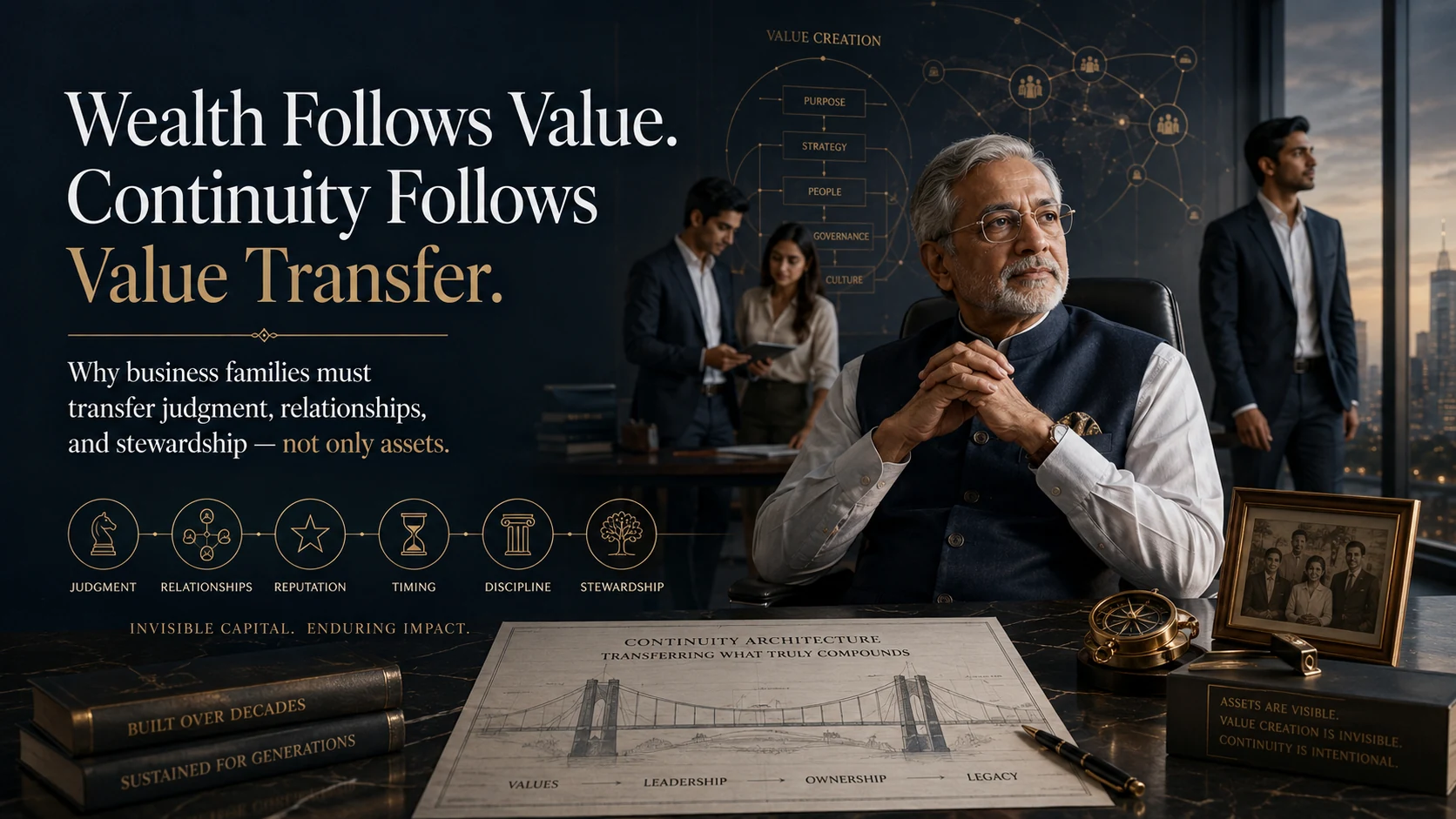

Wealth Follows Value. Continuity Follows Value Transfer.

Why business families must transfer judgment, relationships, and value-creation capacity — not only assets

Wealth does not usually appear first.

Value appears first.

A founder solves a problem.
Builds trust.
Takes risk.
Understands timing.
Protects reputation.
Negotiates carefully.
Keeps promises.
Learns which opportunity to accept and which one to refuse.

Over time, the market rewards that value.

The reward may become a business.
The business may become property.
Property may become family wealth.
Family wealth may become status, security, and influence.

But the visible wealth is not the source.

It is the result.

The source is often less visible: judgment, relationships, discipline, timing, reputation, operating wisdom, and the founder’s ability to create value where others saw only risk or uncertainty.

This distinction matters deeply for business families.

Because assets can be transferred faster than value-creation capacity.

Shares can be gifted.
Properties can be settled.
Bank balances can be distributed.
Documents can be signed.
Trusts can be created.

But if the family transfers the result without transferring the source, wealth may pass while continuity weakens.

The founder’s balance sheet is the result

A founder’s balance sheet rarely tells the full story.

It may show land, companies, investments, loans, deposits, jewellery, family homes, insurance, and business interests.

But it does not show the real operating intelligence behind the wealth.

It does not show why one property was held for twenty years.
It does not show why one customer relationship was protected during a difficult period.
It does not show which supplier stood with the business when capital was tight.
It does not show why the founder avoided one attractive opportunity and pursued another.
It does not show which family member was supported earlier, quietly and without public discussion.
It does not show which relationship carries more economic value than the contract suggests.

The balance sheet records outcomes.

It does not automatically transfer wisdom.

That is why succession cannot be reduced to asset transfer.

A family that inherits assets without understanding how value was created may hold wealth for some time. But it may struggle to renew it, protect it, or govern it with maturity.

A discreet pattern seen in many successful families

Consider a founder-led family where everyone knows the business is valuable.

The children know the properties.
The CA knows the accounts.
The lawyer knows the documents.
The banker knows the facilities.
The family knows the founder is respected.

But only the founder knows the deeper map.

He knows which client relationship must never be treated casually.
He knows which loan should be repaid before expansion.
He knows which relative’s expectation could create future discomfort.
He knows which asset is financially useful but emotionally sensitive.
He knows which employee carries institutional memory.
He knows which next-generation member has ability but lacks patience.
He knows which opportunity looks profitable but could damage reputation.

On paper, the family may appear ready.

In reality, the founder is still the interpreter of value.

If that interpretation is not transferred, the next generation may inherit the family’s assets without inheriting the family’s value system.

That is a continuity risk.

Not because the children are incapable.

But because the family has not yet translated founder wisdom into structure, exposure, governance, and decision discipline.

Wealth transfer is not the same as value transfer

Traditional succession conversations often begin with:

Who gets what?
Which asset goes where?
How should shares be divided?
What should the Will say?
Should a trust be considered?
How do we reduce future conflict?

These are important questions.

But they are not the whole conversation.

A serious business family must also ask:

How was the wealth actually created?
Which decisions created the most value?
Which relationships protect the enterprise?
Which habits preserved reputation?
Which risks were avoided for good reason?
Which family behaviours could destroy value?
Which successors understand the difference between ownership and stewardship?

This is the difference between wealth transfer and value transfer.

Wealth transfer moves assets.

Value transfer prepares the family to understand, protect, and continue the value behind those assets.

A family may complete wealth transfer and still fail at value transfer.

That is where continuity weakens.

The hidden forms of family capital

In founder-led families, financial capital is only one form of capital.

There are other forms that may be even more important during transition.

Judgment capital

The founder’s ability to make decisions under uncertainty.

This includes timing, restraint, negotiation, risk assessment, and knowing when not to act.

Relationship capital

The trust built with customers, lenders, suppliers, employees, advisors, community leaders, and family members.

Some relationships carry enormous economic value even when they do not appear as assets.

Reputation capital

The family name, credibility, payment discipline, fairness, and public conduct that allow the business and family to move with confidence.

Decision capital

The family’s ability to make important decisions without confusion, ego, delay, or fragmentation.

Stewardship capital

The next generation’s ability to receive ownership without entitlement, govern shared assets, and protect what was built without becoming passive custodians.

These forms of capital rarely appear in standard financial statements.

But during succession, they matter.

A family can lose financial wealth if it fails to transfer these invisible forms of capital.

The risk of inheriting ownership without operating wisdom

Ownership gives rights.

It does not automatically give readiness.

A son may inherit shares without understanding the relationships that protect business margins.

A daughter may inherit property without knowing why the founder never wanted it sold.

A non-active branch may inherit economic interest without understanding the pressure carried by the active branch.

An active successor may inherit authority without learning how to communicate decisions with dignity.

A family member may receive wealth but not understand the discipline required to preserve liquidity, reputation, and trust.

This is how value leakage begins.

Not always through conflict.

Sometimes through inexperience.

Sometimes through entitlement.

Sometimes through poor timing.

Sometimes through casual use of money.

Sometimes through neglecting relationships that took decades to build.

Sometimes through assuming that ownership itself creates capability.

It does not.

Ownership must be supported by stewardship.

Value can also leak through generosity without structure

Many founders are generous.

They support family members.
They help relatives.
They give opportunities.
They forgive delays.
They fund education, homes, weddings, business ideas, emergencies, and lifestyle needs.

This generosity may come from love, responsibility, and family duty.

But generosity without structure can create confusion.

One child may see support as fairness.
Another may see it as favouritism.
One branch may treat repeated help as entitlement.
Another may quietly carry resentment.
The founder may believe he is maintaining harmony, while the structure records nothing clearly.

This is not only a financial issue.

It is a value-transfer issue.

The family must distinguish between support, dependency, responsibility, and reciprocity.

Otherwise, the founder’s generosity may weaken the very stewardship he wanted to create.

Price, cost, and value in family decisions

In many families, decisions are evaluated by immediate price.

What will this cost?
What is the fee?
What is the tax?
What is the premium?
What is the legal expense?
What is the short-term outflow?

These are valid questions.

But they are not always the first questions.

A more mature family asks:

What value will this create or protect?
What future problem could this prevent?
What relationship could this preserve?
What clarity could this provide?
What delay could this avoid?
What control could this protect?
What family discomfort could this reduce?

Some decisions look expensive because the price is visible.

But the cost of not making them may be much higher.

An unreviewed structure can become expensive later.

An unclear family understanding can become costly later.

A successor who is not prepared can become costly later.

A liquidity gap discovered during pressure can become costly later.

A weak advisor-coordination process can become costly later.

Serious families should not be careless with cost.

But they should not confuse low price with high wisdom.

The Family Value-Transfer Review

Before a family assumes succession is ready, it should examine whether value-creation capacity is being transferred along with wealth.

I call this the Family Value-Transfer Review.

Its purpose is not to motivate the next generation with generic family values.

It is not a sentimental legacy exercise.

It is a structured review of whether the family understands the sources of its wealth, the risks to those sources, and the readiness of the next generation to protect and continue them.

The central question is:

Can the family transfer not only ownership, but the judgment, relationships, discipline, and decision capacity that made ownership valuable?

What the review examines

1. Value creation history

How was the family wealth actually created?

Through trading skill?
Manufacturing discipline?
Real estate timing?
Professional expertise?
Customer trust?
Distribution strength?
Capital allocation?
Cost control?
Relationships?
Reputation?
One major risk that paid off?

The family must understand the wealth creation story without reducing it to “we own assets.”

2. Founder judgment

Which decisions still depend mainly on the founder?

Who approves major investments?
Who handles difficult negotiations?
Who knows when to say no?
Who understands the real quality of opportunities?
Who can judge character, timing, and reputational risk?

If these decisions remain trapped inside the founder’s instinct, the family has not yet transferred judgment.

3. Relationship capital

Which relationships carry economic or continuity value?

Customers.
Suppliers.
Bankers.
Senior employees.
CAs.
Lawyers.
Trustees.
Joint-venture partners.
Community figures.
Extended family influencers.
Key non-family executives.

The family should know which relationships must be carefully transitioned before the founder steps back.

4. Reputation and trust

What behaviours created the family’s reputation?

Payment discipline.
Discretion.
Fair dealing.
Reliability.
Community standing.
Employee loyalty.
Careful speech.
Honouring commitments.
Avoiding unnecessary disputes.

The next generation must understand that reputation is not inherited permanently.

It must be renewed through conduct.

5. Value leakage

Where is value being lost?

Through entitlement?
Delayed decisions?
Poor governance?
Undocumented support?
Unclear family roles?
Weak successor exposure?
Casual use of business resources?
Neglect of relationships?
Fragmented advisors?
Avoided conversations?

Value leakage is not always visible immediately.

But over time, it can weaken both wealth and family trust.

6. Successor capability

What must the next generation learn before receiving greater authority?

Financial literacy is only the beginning.

They must understand business economics, liquidity discipline, ownership responsibility, family communication, advisor coordination, reputation risk, and the emotional meaning of shared wealth.

The question is not whether they are educated.

The question is whether they are prepared.

7. Governance and role clarity

How will decisions be made when the founder is not personally deciding?

Who can speak for the family?
Who can represent the business?
Who approves support to family members?
Who handles disagreements?
Who communicates with advisors?
Who has voting power?
Who has economic benefit?
Who has operating responsibility?

Without role clarity, ownership can become a source of friction.

8. Documentation of intent and context

Are the founder’s intentions documented with enough context?

Legal documents may transfer assets.

But they may not explain why certain decisions were made.

In some families, a letter of wishes, family note, governance charter, family council process, shareholder arrangement, trust structure, or documented continuity map may help preserve context.

The exact method depends on the family.

The principle remains the same:

Do not transfer assets without transferring meaning.

Why this review should happen while the founder is active

Value transfer cannot be done properly after the founder is no longer available to explain his logic.

By then, the family may know what he owned.

But not why he arranged it that way.

They may know which assets exist.

But not which relationships mattered.

They may know the documents.

But not the intention behind difficult decisions.

They may know who received what.

But not the history of support, sacrifice, contribution, and expectation.

The best time to transfer value is while the founder can still teach, clarify, correct, and guide.

Not through lectures.

Through structured exposure, documented intent, advisor coordination, family conversations, and progressive responsibility.

Why this matters for advisors and introducers

This subject also matters to the family’s professional circle.

A CA may understand the accounts but not the family’s stewardship risk.

A lawyer may draft documents but not know whether the next generation understands the founder’s intent.

A banker may understand facilities but not know which relationships are founder-dependent.

An investment advisor may understand portfolios but not know whether future owners can govern capital responsibly.

Each professional may hold one part of the picture.

But value transfer requires a wider continuity lens.

That is why serious families need coordination, not isolated advice.

The better question

A successful family should not only ask:

“How do we transfer wealth?”

It should ask:

“How do we transfer the value-creation capacity that made the wealth possible?”

That question changes the nature of succession.

It moves the family beyond distribution.

It brings attention to founder judgment, relationship capital, next-generation readiness, governance, documentation, and continuity discipline.

Final thought

Wealth follows value.

But continuity follows value transfer.

The founder’s balance sheet is the result.

His judgment, relationships, discipline, timing, reputation, and restraint are the source.

If the family transfers the result without transferring the source, ownership may pass but continuity may weaken.

A serious business family should not wait until transition pressure begins to ask whether the next generation is ready.

It should examine the value engine while the founder is active, the family is calm, and the story can still be told accurately.

That is the work of continuity architecture.

Not motivational legacy talk.

Not product-selling.

Not documents in isolation.

A private, structured review of whether the family is prepared to transfer not only assets, but the judgment and value system that made those assets worth preserving.


If your family wealth was built through founder judgment, business relationships, reputation, and years of disciplined decision-making, it is worth examining whether those value-creating capacities are being transferred with the assets.

A private Family Value-Transfer Review helps business families assess whether ownership succession is supported by judgment transfer, relationship continuity, next-generation readiness, and governance clarity.


Share.

Dr(HC) Sandeep N. Setty is a Bengaluru-based Family Continuity Architect advising business families, founders, promoter families, and affluent clients on continuity, control clarity, liquidity readiness, succession, governance, ownership structuring, estate equalization, and implementation coordination. His work focuses on helping families move from accumulated wealth to continuity-ready wealth by aligning family intent, ownership structures, documentation, decision rights, and advisor execution. He works discreetly with families and their existing CAs, lawyers, bankers, trustees, and key advisors where wealth, business interests, entities, and family dynamics have become too important to leave informal.