
Continuity Insights
When the Founder Cannot Act: The First Five Decisions
By Sandeep N. Setty · 17 October 2026
By Sandeep N. Setty · Family Continuity Architect
A family may have signed wills and identified a successor, but still lack a reliable answer: Who can make a consequential decision tomorrow if the founder is suddenly unavailable?
Consider a fictional Bengaluru manufacturing family. The founder still approves critical financing, senior appointments, property negotiations and exceptions. Two adult children work in different roles. The board has formal authority; bank mandates grant particular signatures; everyone assumes someone will know what to do. These are not necessarily the same answers.
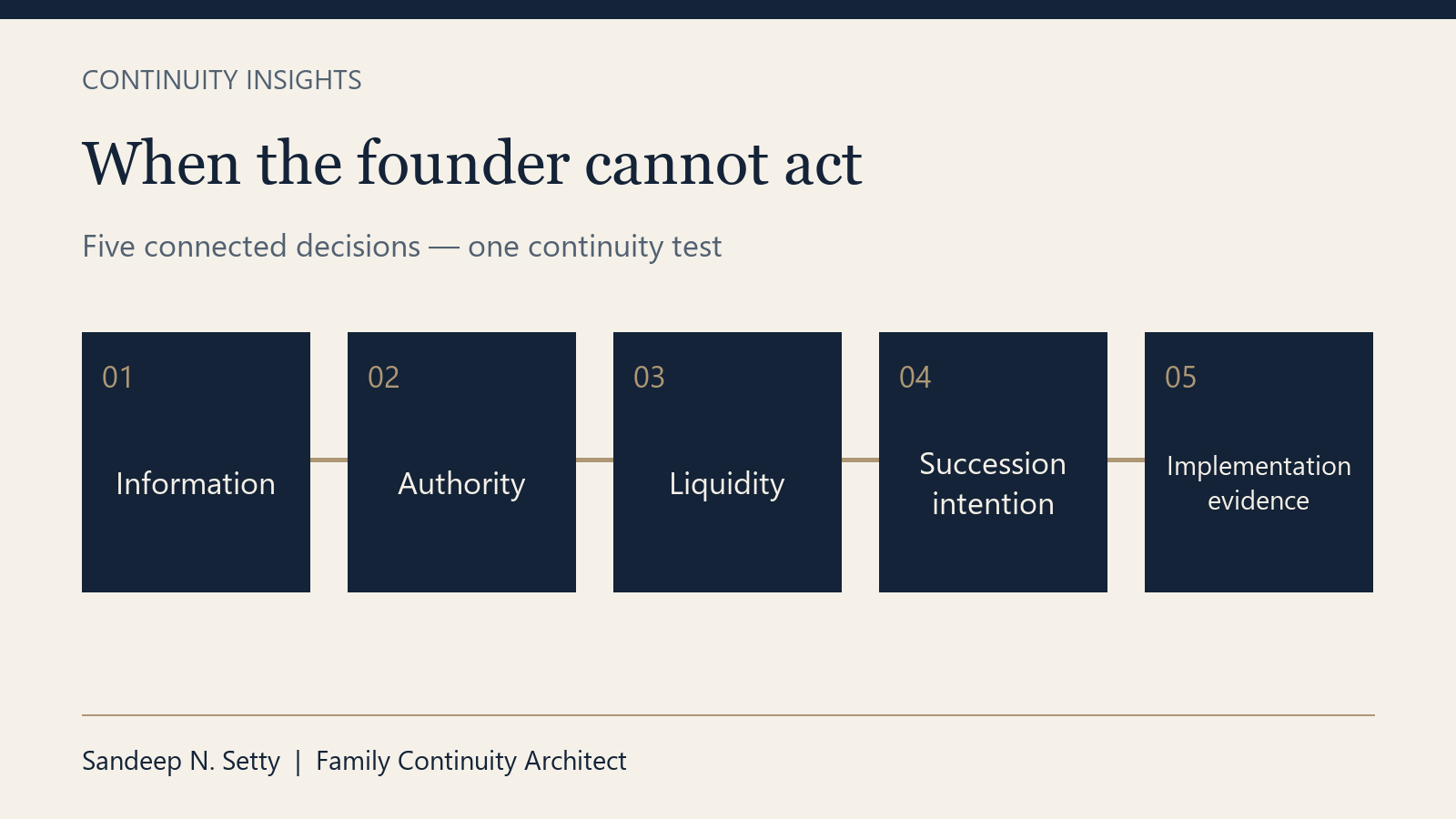
Five connected decisions
- Information. Who can lawfully access current liabilities, guarantees, commitments, key contacts and deadlines without depending on the founder’s memory?
- Authority. Who may sign contracts, operate accounts, approve borrowing, appoint management or exercise voting rights? What other permissions apply?
- Continuity liquidity. What must be paid in the first 30, 60 and 90 days? Where is genuinely accessible capital held, and who may authorise its use?
- Succession intention. Have the family members separated inheritance, operating responsibility, economic benefit and control?
- Implementation evidence. Which documents, board decisions, bank mandates and access arrangements have actually been completed and tested?
A will can address aspects of transfer after death but does not automatically confer interim business, banking or corporate authority. The relevant lawyer, CA, company secretary, banker and other appointed advisers must confirm the legal position.
A Family Continuity Diagnostic separates confirmed facts, intentions, assumptions and unresolved family decisions before structures or products are considered. See also founder dependency.
The question to test: Could your enterprise and household make the next necessary decision without relying on the founder’s private memory?
Request a private relevance conversation; do not send sensitive documents initially.
Fictional educational illustration, not a client outcome or legal, tax, banking, privacy, fiduciary, insurance or investment advice. Qualified appointed specialists must verify individual conclusions and implementation.