
Continuity Insights
Overseas Beneficiaries: Who Owns the Continuity Decision?
By Sandeep N. Setty · 17 October 2026
By Sandeep N. Setty · Family Continuity Architect
Family members may agree who should benefit from wealth while still disagreeing, or remaining unclear, about who can make each necessary decision. Cross-border beneficiaries intensify this problem.
Imagine a fictional Indian-origin family with a Bengaluru enterprise, Indian property, accounts outside India and adult beneficiaries in the United Kingdom and North America. The founder wants fairness across children, a workable enterprise succession and dependable resources for a surviving spouse. Several advisers have addressed separate questions, but nobody has mapped the connections between them.
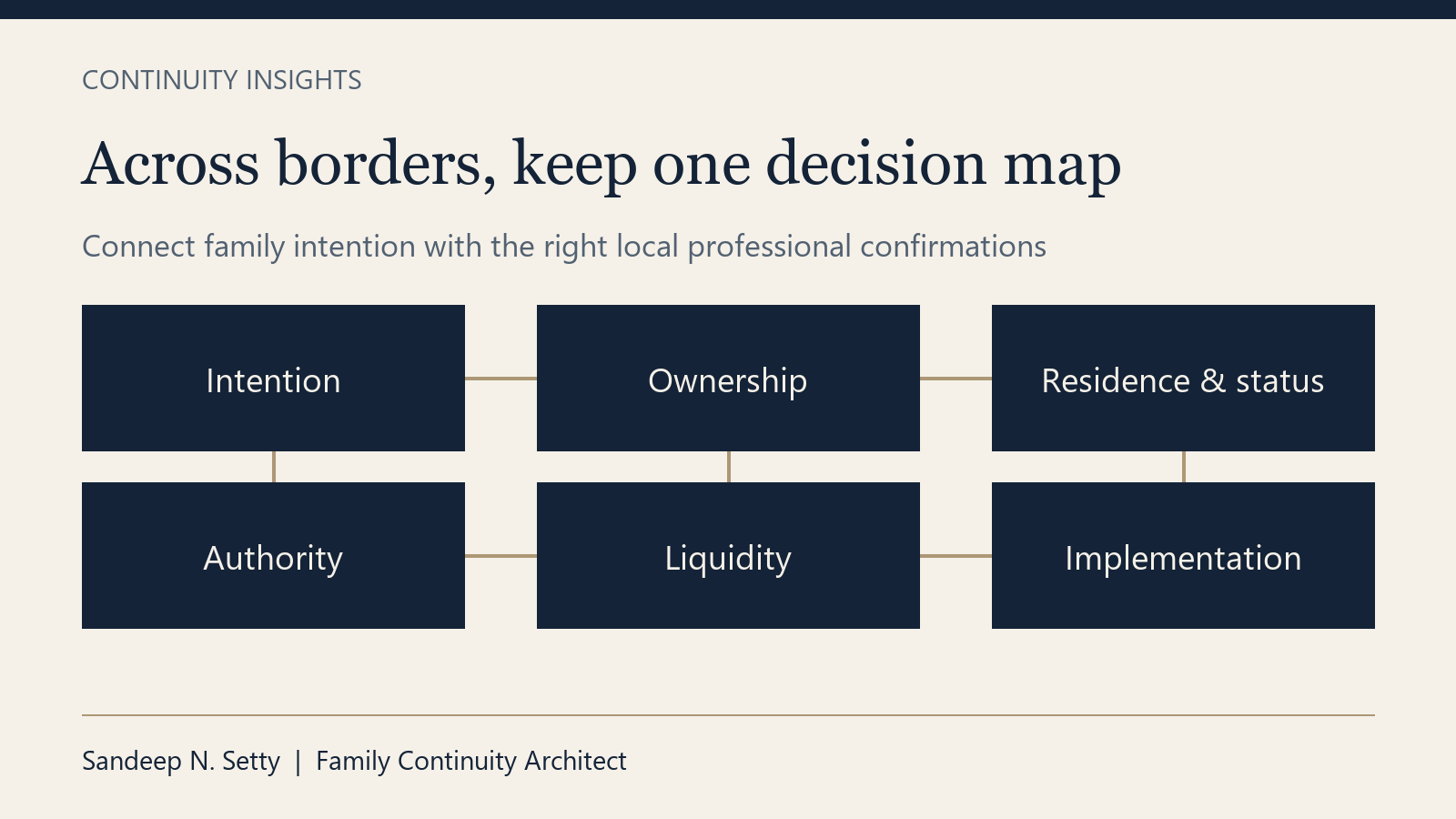
Six parts of the decision map
- Intention: Who should receive benefit, control the enterprise, manage it and support dependants?
- Ownership: Which person or legal entity holds each asset and where is it situated?
- Residence and status: Which facts create tax, foreign exchange, reporting or succession questions for qualified local professionals?
- Authority: Who may appoint a trustee, approve distributions, vote, replace a signatory or resolve conflict?
- Liquidity: Where are funds held, who may access them and when may they lawfully be transferred?
- Implementation: Which specialists have confirmed conclusions, and where is each still-open approval recorded?
Do not infer another jurisdiction’s legal or tax treatment merely from a beneficiary’s residence or an asset’s location. For Indian-connected structures, appointed specialists should examine relevant FEMA/RBI, tax, company, trust and succession requirements together with overseas law.
A continuity architecture is a common decision framework—not a replacement for local legal or tax advice. It makes the professional hand-offs and dependencies explicit before anyone recommends a particular vehicle or product.
The test: If the family faced a time-sensitive decision tomorrow, who would hold the complete decision map—and what confirmations would still be missing?
Read the related fictional case and diagnostic approach.
Fictional educational illustration, not a client outcome or legal, tax, banking, privacy, fiduciary, insurance or investment advice. Qualified appointed specialists must verify individual conclusions and implementation.