
Continuity Insights
The decision route behind succession
By Sandeep N. Setty · 30 October 2026
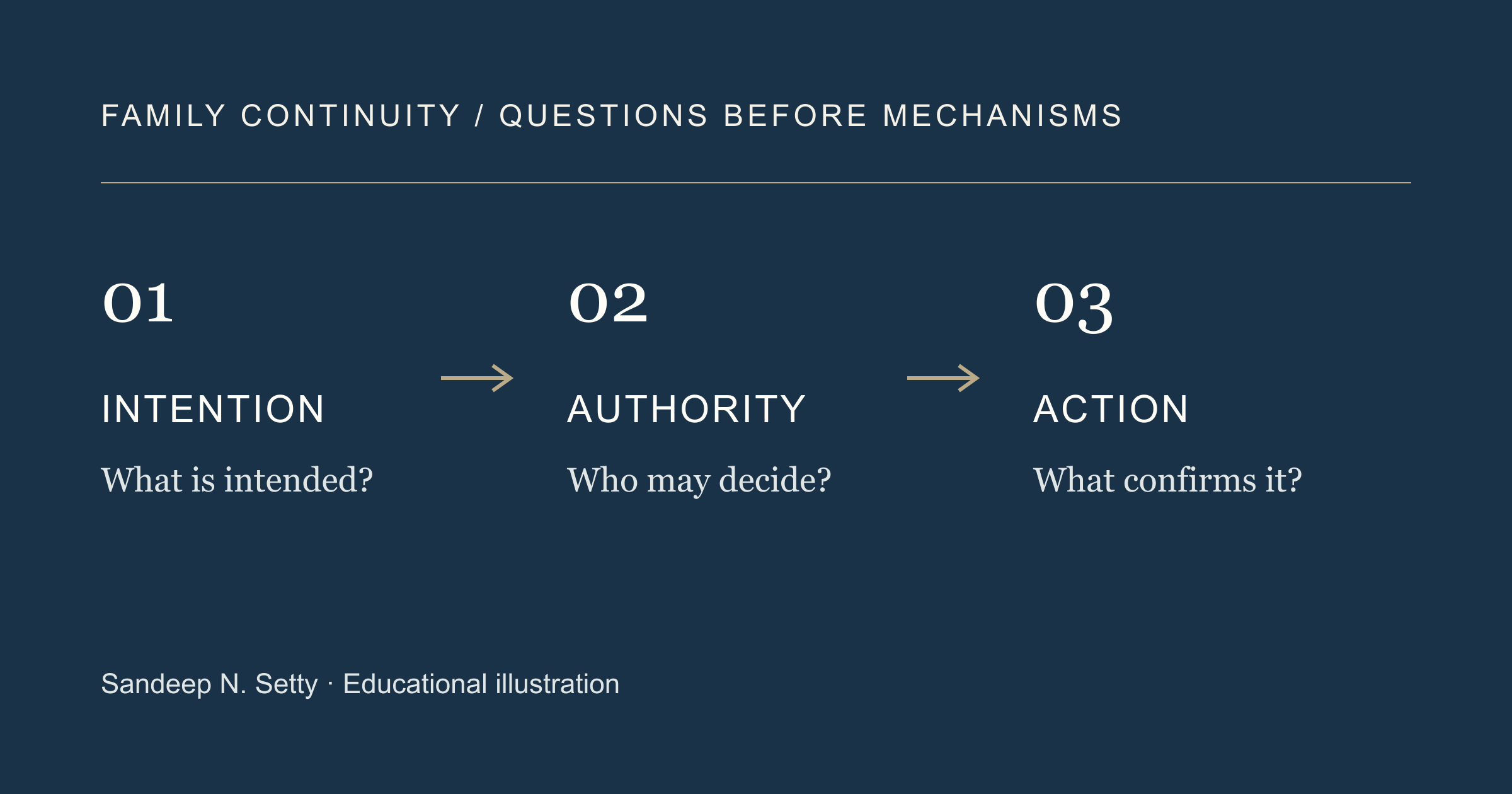

A successor may have the title, the experience and the family’s confidence. Yet the next important decision can still wait for the founder.
This is where succession becomes practical. Who can act, using what information, within which boundaries? The answer needs to hold when the founder is travelling, unavailable or deliberately stepping back.
Consider a fictional family business preparing for a leadership transition. The successor manages day-to-day operations. A long-standing supplier proposes a contract requiring a larger commitment than usual. The successor understands the commercial opportunity, but the approval limit is unclear. Finance has not shared the latest cash-flow position. The bank’s signing arrangement still depends on the founder. Each person is doing their assigned work, while the decision remains suspended between them.
Another succession announcement would not resolve those dependencies. Nor would a document, by itself, establish that the successor has the information and operating route needed to exercise the intended authority.
The family has choices. It could give the successor broad authority within agreed limits, supported by reporting and review. That may improve speed, while placing greater demands on judgement and oversight. It could introduce staged delegation, allowing capability and controls to develop through experience. That may reduce the size of early mistakes, while preserving delays if every exception returns to the founder. It could retain founder approval for major commitments. That may be an intentional choice, provided the resulting dependence is understood and an absence arrangement is considered.
There is no universal answer in this example. Participation, speed, control and reversibility matter differently to different families. The useful task is to make those trade-offs visible before selecting the mechanism.
I would begin by tracing one ordinary decision and one exception. Who identifies the need? Which information must be available? Who can approve, and whose consent is required? Who carries out the decision? What evidence shows that the intended action took effect?
That sequence often reveals questions that sit between professional briefs. The family may need to settle an intention before the lawyer can formalise it. Finance may need to establish what commitment can be supported. The bank may need to confirm the operative mandate. A continuity brief connects those dependencies while leaving each specialist responsible for their own conclusions and work.
A written register can be simple: the decision, its owner, the required confirmation, the next action and the evidence still missing. Its value comes from the distinction between statuses. Proposed authority is different from agreed authority. A signed instruction is different from an acknowledged and usable arrangement. A completion claim should identify the evidence on which it rests.
The successor also needs room to exercise judgement. A framework that formally delegates responsibility while informally requiring approval for every meaningful choice can preserve the same dependency under a new title. The founder’s intended continuing role deserves the same clarity: which decisions remain theirs, what information they receive and when intervention is appropriate.
Review matters because the circumstances will change. A larger business, a different ownership mix or a change in the successor’s responsibilities may alter the original assumptions. Agree who notices those changes and when the decision route should be revisited.
Succession becomes more credible when a family can explain how an important decision will move from intention to action. Sometimes the appropriate next step is a focused clarification with existing advisers. Sometimes several connected questions justify a wider review. The scope should follow what remains unresolved.
This is a fictional educational illustration. Any family-specific legal, banking, tax or other professional conclusion requires the appropriately appointed specialist.